
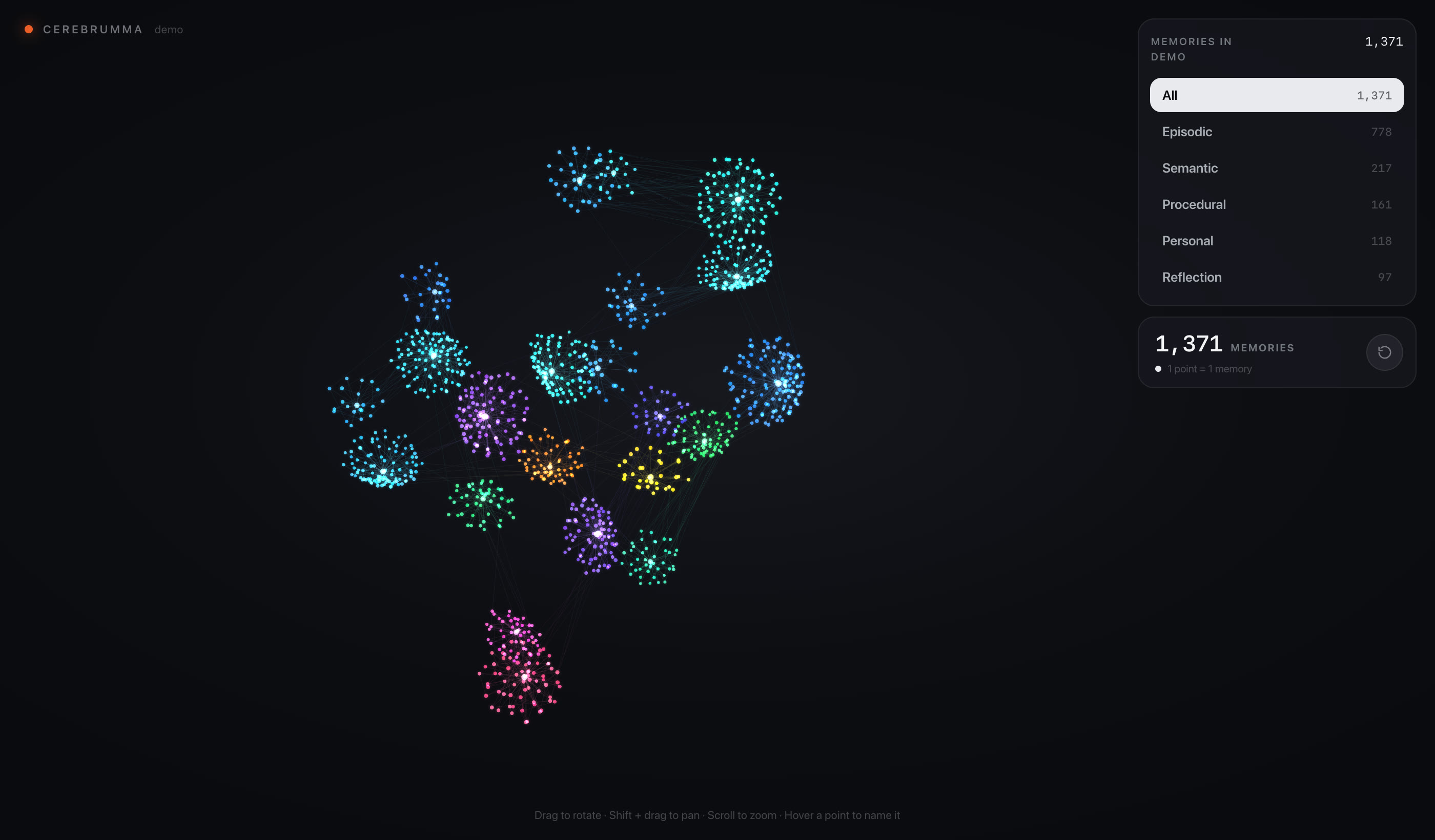
Cerebrumma started as a memory layer for one developer and their AI tools. Version 0.2 is the first release built for something bigger: agents that act on your behalf need to know which knowledge they are allowed to trust. This release adds that, makes the installer verifiable, smooths the first five minutes, and replaces the neural map with one worth looking at.
Upgrade #
$ curl -fsSL https://get.cerebrumma.com | shOr brew upgrade cerebrumma if you installed with Homebrew. Then run cerebrum hook install once in each project to pick up the improved git hook.
The governed Business Brain #
Ordinary memories stay flexible. But when an agent drafts a customer reply or quotes a price, “something I noticed last Tuesday” is not good enough. 0.2 lets you mark entries as governed runtime knowledge, each with an owner, an authority level, a scope of agent roles, a customer-safety flag, and an autonomy level.
cerebrum validaterejects duplicate IDs, missing approvals, invalid dates, and two active entries that claim the same truth without one superseding the other.cerebrum publishwrites a deterministic snapshot. The Brain version is a hash of the approved content, so the same knowledge always produces the same version, and agents can log exactly which version and memory IDs shaped an action.- A new MCP tool,
get_business_context, serves only that snapshot, filtered by role and customer safety. - Dream cycles can propose knowledge but can never approve it. Anything generated by reflection needs a named human reviewer.
Read the full model in the Business Brain docs.
Hardening before launch #
We audited the Business Brain right after it landed and fixed what we found:
- The MCP tool now re-checks expiry and effective dates when it reads. Previously, a snapshot published last month could keep serving an approval that had since expired.
- The MCP
add_entrytool only writes to theepisodic,semantic, andpersonallayers, closing a path-traversal hole. - Republishing unchanged knowledge leaves
brain.jsonuntouched, so a tracked snapshot only changes in git when the Brain does. - The docs now say plainly that role filtering keeps agents on task but is not access control. Gate approvals with pull-request review.
An installer you can verify #
curl | sh asks for trust, so the installer now earns it. It downloads the SHA-256 checksum that CI publishes with every release and refuses to install if the binary does not match. There is still no telemetry and no account. Prefer to read it first? Download the script, read it, then run it:
$ curl -fsSL https://get.cerebrumma.com -o install.sh && less install.shThe Homebrew tap now tracks the latest release too.
A smoother first five minutes #
cerebrum inittells you whether the git hook was installed, and why not if it was skipped.cerebrum whyno longer says a bare “no matches”. It tells you when recent memories mention your term but have not been promoted by a dream cycle yet, or points you tocerebrum search.- Commit capture lists at most five files plus a count, skips the Brain’s own files, and works on a repository’s very first commit.
cerebrum statssays which Brain it is reading, anddaemon stopsays so when nothing is running.
A new neural map #
The old map put every memory on one tangle of lines. The new cerebrum map --graph groups related memories into topics. Each topic has a hub, the memory most connected to the rest, with its other memories placed around it on a golden-angle spiral wrapped around a sphere. The result is a small 3D galaxy that stays round from every angle, dense at the core and sparse at the edges. Topics that share connections pull together into chains.
The idea comes from Rob Phillips’ knowledge graph for his daughter’s schooling, where each skill sits at the center of the exercises that prove it, distributed with the golden ratio. A memory topic works the same way: a central idea surrounded by everything that supports it.
- Pick a layer to isolate it. The camera flies to it and everything else fades back.
- Press
/to open a searchable list of every memory, grouped by topic. Matches glow in place, and clicking a row flies you to it. - Hover any point to read the memory, with its connections drawn in white.
- The map grows topic by topic as it opens, then drifts slowly when idle.
- It is still a single offline HTML file. Nothing leaves your machine.
Try it on the live demo, or run it on your own Brain:
$ cerebrum map --graphWhat’s next #
Signed snapshot distribution for hosted agents, an evaluation gate that has to pass before a new Brain version is promoted, and team Brains shared over git. Follow along on GitHub.